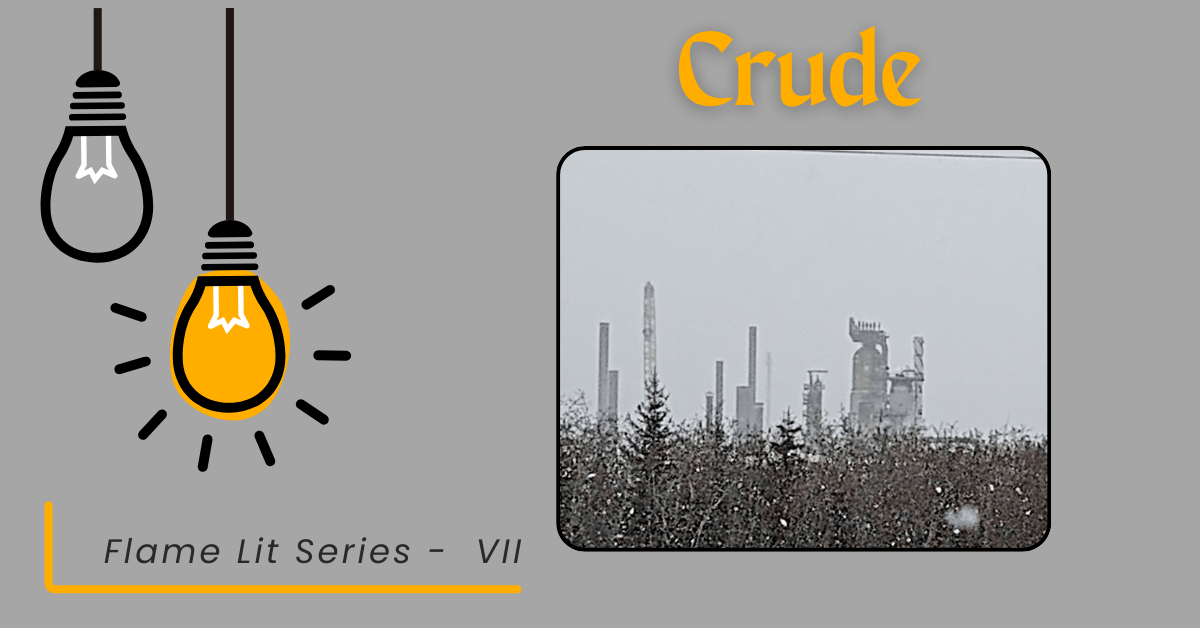
Flame Lit – Part VII – A limited micro-blog series of energy definitions and quick facts to help improve energy literacy
photo/graphic by author
What is crude oil? Unlike natural gas or gasoline, it is much harder to define “crude oil” – it isn’t a single molecule or “mostly from” a single molecule.
In basic terms, it is unprocessed oil that comes from underground and is used to make products we use like gasoline, diesel, and jet fuel. Here’s a pretty good explanation!
Are you picturing Jed Clampett firing his shot gun and “up from the ground came a bubbling crude?” It’s kinda true. Crude oil was first produced in North America from shallow wells under pressure. Oil flowed easily from them and became a cheap and reliable energy source.
The first commercial oil well in Canada was established in southwestern Ontario and you can visit the Oil Museum of Canada in Lambton today.
In Canada, most “conventional” oil wells are in the prairies. Oil produced from these wells flows into a “gathering system” (small pipelines) and is then transported to refineries in places like Edmonton, Sarnia, and the US Midwest.
As we used more oil and new conventional supply dwindled, we began to search for oil in alternate places. Today a good portion of Canada’s oil comes from “unconventional” sources such as deep wells, offshore oil rigs, and oilsands deposits.
Oil sands in northern Alberta are sands that have bitumen, a thick fossil fuel, embedded in them. Bitumen is separated from the sands and then diluted with another fluid and fed to an upgrader. The upgrader processes the oil to make a “synthetic crude” which is shipped in pipelines to refineries.
Advances in technology made it possible to ship diluted bitumen (or “dil bit”) directly to oil upgraders and refineries outside of northern Alberta. Other advances, such as SAGD (steam assisted gravity drainage) made it possible for producers to extract bitumen from special wells instead of open-pit mines.
So how much oil does Canada produce and how much do we use? In 2023 we made 5.1 million barrels a day (mbpd). We shipped most of that – 4.0 mbpd to the US.
Why doesn’t Canada “refine” its own oil? We do!!
The crude oil we don’t ship to the US is fed to one of 17 refineries spread across the country. Those refineries process about 70% Canadian crude to make refined petroleum products, or RPP’s, that we consume in Canada. We also export some refined products and import in places we are short.
Why don’t Canadian refineries use Canadian crude exclusively? There are two main reasons. First, our major oil pipelines do not stretch all the way to the east coast. Refiners there rely on tankers to bring in oil from the US and other countries. Second, those older refineries were made for a slate of “light, sweet crude” that is different from what western Canada ships.
Canada has doubled its crude oil exports to the US since 2010. Most of this oil is transported on the Enbridge pipeline to the US Midwest, and Keystone and TMX pipelines to the south and west.
Nothing beats a good picture and here is a great crude oil system map of North America.
US refiners use 60% of their own crude oil but also run 20-25% Canadian crude feed. (The U.S. also exports some crude!). In 2023, the total value of oil exported to the US was $134 B.
Canada was the fourth largest producer of crude oil in 2024 behind the USA, Russia, and Saudi Arabia.
Some Crude Oil quick facts:
- Canada produced 5.1 million barrels of oil a day (or mbpd)* in 2023 and exported 4.0 mpbd.
- Canada refined 1.6 mbpd of crude oil in 2023 to produce products like gasoline, diesel, and jet fuel.
- Canada’s 16 refineries (including 2 asphalt) are located in Alberta, Ontario, Quebec, Saskatchewan, BC, New Brunswick, and Newfoundland.
- 84% of Canada’s crude production is from Alberta followed by Saskatchewan and Newfoundland
- Canada’s oil makes up 60% of the total crude oil volume imported by the US in 2023.
Next: Electricity
Use these links for a more in-depth look:
- Canadian Energy Regulator
- Crude Oil Industry Overview (National Resources Canada)
- Oil Supply and Demand (National Resources Canada)
- Oil Sands Extraction and Processing (National Resources Canada)
- Canadian Association of Petroleum Producers
- Canada’s Oil Pipeline Capacity
- Energy Information Administration
Alisa Caswell has a degree in chemical engineering. She spent twenty years working in the oil and gas industry, including roles in business development, operations, and energy conservation. You can follow her on Facebook , LinkedIn, or Twitter.
 Alisa Caswell
Very good article Mrs Boo.
LikeLiked by 1 person